| |
| Around
and about Uluru - Ayers Rock in Northern Territory
Australia A motorhome selfdrive hire tourist guide |
|
|
Uluru, also known as Ayers Rock Welcome
to Aboriginal land Pukulngalya yanama, Ananguku Ngurakutu (welcome greeting
in Yankunytjatjara) Pukulpa Pitjama, Ananguku Ngurakutu (welcome greeting
in Pitjantjatjara) The traditional
land owners of Uluru-Kata Tjuta National Park, are direct descendants of the beings
who created our lands during the Tjukurpa (Creation Time). We have always been
here. We call ourselves Anangu, and would like you to use that term for us. Uluru-Kata
Tjuta National Park is a world-class visitor destination and a key part of Australia's
iconic Red Centre. This living cultural landscape is the physical and metaphoric
heart of Australia, and was one of the first areas to be identified as a National
Landscape. Ayres rock Uluru, also
referred to as Ayers Rock, is a large sandstone rock formation in the southern
part of the Northern Territory, central Australia. It lies 335 km (208 mi) south
west of the nearest large town, Alice Springs; 450 km (280 mi) by road. Kata Tjuta
(The Olgas) and Uluru are the two major features of the Uluru - Kata Tjuta National
Park. Uluru is sacred to the Pitjantjatjara and Yankunytjatjara, the Aboriginal
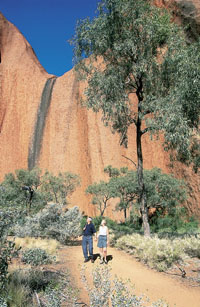
people of the area. It has many springs,
waterholes, rock caves and ancient paintings. Uluru is listed as a World Heritage
Site. The local Pitjantjatjara people call the landmark Uluru . This word has
no particular meaning in their dialect, also known as Pitjantjatjara, but it is
also used as a local family name by the senior Traditional Owners of Uluru. On
19 July 1873, the surveyor William Gosse visited Uluru and named it Ayers Rock
in honour of the then-Chief Secretary of South Australia, Sir Henry Ayers. Since
then, both names have been used, although Ayers Rock was the most common name
used by outsiders until recently. In 1993, a dual naming policy was adopted that
allowed official names that consist of both the traditional Aboriginal name and
the English name. On 15 December 1993,
it was renamed "Ayers Rock/Uluru" and became the first officially dual-named feature
in the Northern Territory. The order of the dual names was officially reversed
to "Uluru/Ayers Rock" on 6 November 2002 following a request from the Regional
Tourism Association in Alice Springs. Uluru
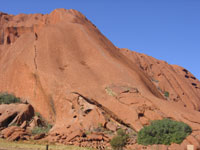
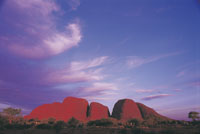
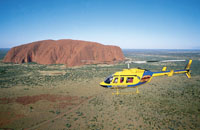
is one of Australia's most recognisable natural icons. The world-renowned sandstone
formation stands 348 m (1,142 ft) high (863 m/2,831 ft above sea level) with most
of its bulk below the ground, and measures 9.4 km (5.8 mi) in circumference. Uluru
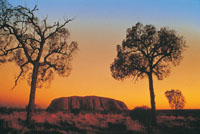
is notable for appearing to change colour as the different light strikes it at
different times of the day and year, with sunset a particularly remarkable sight
when it briefly glows red. Although rainfall is uncommon in this semiarid area,
during wet periods the rock acquires a silvery-grey colour, with streaks of black
algae forming on the areas that serve as channels for water flow. Uluru is an
inselberg, literally "island mountain", an isolated remnant left after the slow
erosion of an original mountain range. Uluru is also often referred to as a monolith,
although this is a somewhat ambiguous term because of its multiple meanings, and
thus a word generally avoided by geologists. The
strata at Uluru are nearly vertical, dipping to the south west at 85°, and have
an exposed thickness of at least 2,400 m (7,900 ft). The strata dip below the
surrounding plain and no doubt extend well beyond Uluru in the subsurface, but
the extent is not known. Cultural
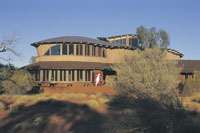
Centre When you visit Uluru - Kata Tjuta National Park, you should ensure
that you explore the Cultural Centre first. You will enjoy exploring the Park
much more if you understand Anangu culture and this very special cultural and
natural environment. At the Cultural
Centre you can get an introduction to Tjukurpa (law, knowledge, religion, philosophy),
Anangu art, Anangu way of life (traditional and current), history, languages,
wildlife and joint management of the Park. The displays feature photo collages,
oral history sound panels, Pitjantjatjara language learning interactives, soundscapes,
videos and artefacts. There are bush tucker sessions, plants walks and cultural
sessions for visitors to experience. Cultural Centre notes are provided in Pitjantjatjara,
English, Italian, Japanese, German and French. A touch wall for visually impaired
people ensures that the messages are accessible to everyone. Daily schedules vary,
so ask at the Cultural Centre Information Desk. Park
Fees |  |
 |
 |
 |
 |
 |
|
|
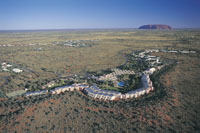
Ayers Rock Resort Regardless
of where you stay while you're at Voyages Ayers Rock Resort, from the sanctuary
of one of the five hotels, or the intimacy of Voyages Ayers Rock Resort Campground,
you can experience the beauty of the living cultural landscape of Uluru-Kata Tjuta
National Park, in Australia's Northern Territory. With over 65 tours, local activities
and attractions within the Resort and the Uluru-Kata Tjuta National Park, your
days will be action-packed. Ride a camel across the desert dunes. Hop on a Harley,
or embark on a base walk of Uluru (Ayers Rock). Getting
There - Ayers Rock Resort - Ayers Rock Airport
Fly direct to the heart of Australia ... You can fly daily from Perth, Sydney,
Cairns and Alice Springs direct to Ayers Rock Airport. Direct flights operate
twice a week from Melbourne. Flights from Darwin and Brisbane connect from Alice
Springs through to Ayers Rock Airport. Ayers Rock Airport is conveniently located
just six kilometres from Voyages Ayers Rock Resort (10 minutes' travel). The airport
services both fixed and rotary winged aircraft and receives up to on average 350,000
- 400,000 commercial passengers per year. It's also a popular stopping off point
for private pilots and passengers travelling in their own aircraft. From Ayers
Rock Airport, you can enjoy scenic desert flights over Uluru and Kata Tjuta. You
will find hire car companies, tour desks, a Qantas desk, Ayers Rock Design retail
outlet, and an information desk at the airport. Airport
Transfers - Complimentary return coach transfers from Ayers Rock Airport to
Voyages Ayers Rock Resort meet every scheduled flight. The return transfer to
Ayers Rock Resort Airport collects you from your hotel approximately 2 hours prior
to flight departure please check with reception for exact time. http://www.ayersrockresort.com.au/ |  |
 |
 |
|
Kata Tjuta (The Olgas)Both
Uluru and Kata Tjuta have great cultural significance for the Anangu Traditional
landowners, who lead walking tours to inform visitors about the local flora and
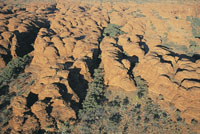
fauna, bush foods and the Aboriginal dreamtime stories of the area. Kata
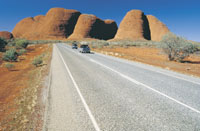
Tjuta, also called Mount Olga or The Olgas owing to its peculiar formation, is
another rock formation about 25 km (16 mi) from Uluru. Special viewing areas with
road access and parking have been constructed to give tourists the best views
of both sites at dawn and dusk. The
rock was originally sand, deposited as part of an extensive alluvial fan that
extended out from the ancestors of the Musgrave, Mann and Petermann Ranges to
the south and west, but separate from a nearby fan that deposited the sand, pebbles
and cobbles that now make up Kata Tjuta. The
similar mineral composition of the Mutitjulu Arkose and the granite ranges to
the south is now explained. |  |
 |
|
|
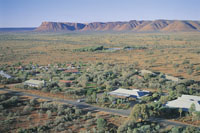
Kings Canyon in Watarrka National Park Voyages
Kings Canyon Resort is located in a loop off the main highway running between
Ayers Rock and Alice Springs. The sensitively designed resort is just seven kilometres
from Watarrka National Park, the home of the magical sandstone formation of Kings
Canyon. Due to Voyages commitment
to best environmental practice, the resort has been built to blend harmoniously
with the surrounds. Kings Canyon Resort offers a wide range of accommodation from
the campground that enjoys the outdoor stillness of the Red Centre to deluxe spa
rooms - offering understated comfort rather unexpected in such a remote location.
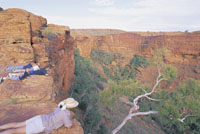
It is the perfect oasis from which to explore the wonders of Kings Canyon including
the amazing rock formation called the Lost City and the Garden of Eden an oasis
of an entirely different kind at the foot of the Canyon. The flora of Kings Canyon
offers a clear indication that the climate of this whole area was once vastly
different. Getting There There
is no better way to explore Central Australia then at your own pace. As Kings
Canyon lies just 3 hours from Uluru (Ayers Rock) and approx. 4 hours from Alice
Springs, self drive is a popular option. The drive passes some incredible sites
including Standley Chasm, Ellery Creek and Ormiston Gorge. The
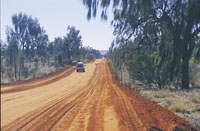
Mereenie Loop Road brings you right to the doorstep of the Resort. Please note:
the Mareenie Loop Road is an unsealed road for 197km of 337km, a 4WD is required.
Alternatively travel via the Stuart Highway, approx. distance from Alice Springs
to Kings Canyon 461km and 4.5 hours travelling time. http://www.kingscanyonresort.com.au/
|  |
 |
 |
|
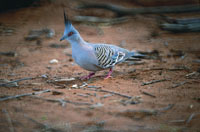
Flora and Fauna in Uluru Kata Juta National
ParkAnangu acknowledge that a
decrease in the number has implications for the condition and health of the landscape.
Moves are supported for the reintroduction of locally extinct animals such as
Malleefowl, Common Brushtail Possum, Rufous Hare-wallaby or Mala, Bilby, Burrowing
Bettong and the Black-flanked Rock-wallaby. The
Mulgara, the only mammal listed as vulnerable, is mostly restricted to the transitional
sand plain area, a narrow band of country that stretches from the vicinity of
Uluru to the Northern boundary of the park and into Ayers Rock Resort. This area
also contains the marsupial mole, Woma Python and Great Desert Skink. The bat
population of the park comprises at least seven species that depend on day roosting
sites within caves and crevices of Uluru and Kata Tjuta. Most of the bats forage
for aerial prey within 100 m (330 ft) or so from the rock face. The
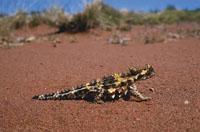
park has a very rich reptile fauna of high conservation significance with 73 species
having been reliably recorded. Four species of frog are abundant at the base of
Uluru and Kata Tjuta following summer rains. The
Great Desert Skink is listed as vulnerable. Anangu continue to hunt and gather
animal species in remote areas of the park and on angu land elsewhere. Hunting
is largely confined to the Red Kangaroo, Bush Turkey, Emu and lizards such as
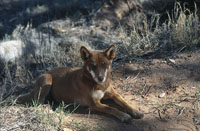
the Sand Goanna and Perentie. Of the 27 mammal species found in the park, six
are introduced: the House Mouse, camel, fox, cat, dog and rabbit. These species
are distributed throughout the park but their densities are greatest in the rich
water run-off areas of Uluru and Kata Tjuta. Uluru - Kata Tjuta National Park
flora represents a large portion of plants found in Central Australia.
A number of these species are considered rare and restricted in the park or the
immediate region. There are many rare and endemic plants at Uluru and Kata Tjuta.
The growth and reproduction of plant communities rely on irregular rainfall. Some
plants are able to survive fire and some are dependent on it to reproduce.
Plants are an important part of Tjukurpa, and there are ceremonies for each of
the major plant foods. Many plants are associated with ancestral beings.
Trees such as the Mulga and Centralian Bloodwood are used to make tools such as
spearheads, boomerangs and bowls. The red sap of the bloodwood is used as a disinfectant
and an inhalant for coughs and colds. There are several rare and endangered species
in the park. Most of them, like Adder's Tongue
ferns, are restricted to the moist areas at the base of the formation, which are
areas of high visitor use and subject to erosion. Since the first Europeans arrived,
34 exotic plant species have been recorded in the park, representing about 6.4%
of the total park flora. Some, such
as perennial buffel grass (Cenchrus ciliaris), were introduced to rehabilitate
areas damaged by erosion. It is the most threatening weed in the park and has
spread to invade water- and nutrient-rich drainage lines. A
few others, such as burrgrass, were brought in accidentally, carried on cars and
people. |  |
 |
 |
 |
 |
| | |
| The
Goholi Our Mission Statement
As one of Australia's largest licensed Travel Agents Goholi
is dedicated to
campervan and motorhome hire and rentals.
We will source the different options for you. We will look at all the extras and
find the best vehicle package for you or even a multiple option for you to choose
from. With our head Office in the heartland of the Top End of Darwin we can advise
you of the current situatuions of Uluru Kata Tjuta National Park - Ayers Rock,
Watarrka National Park,
West MacDonnell Ranges, East MacDonnell Ranges, Kakadu National
Park, Uluru (Ayers Rock), Gibb River Road Western Australia and the - Erlunda
- Kulgera - Odnadatta Track - Coober Pedy (Opal field) - Woomera - Port Augusta
areas. We
have pickup locations in Sydney in New South Wales, Brisbane and Cairns in Queensland,
Darwin and Alice Springs in Northern Territory, Ayers Rock (Uluru) for 2WD cars,
Perth and Broome in Western Australia, Adelaide in South Australia, Melbourne
in Victoria and Hobart in Tasmania Australia's Island State. As one of Australia's
largest campervan, recreational vehicle, motorhome and 4WD rental brokers, we
search for availability and the best deals from campervan, motorhome, winnebago's,
RV Recreational Vehicles, Mobile Homes and 4WD reputable companies throughout
Australia for the vehicle of your choice with so that your Australian vacation
will be the best you've ever had. At Goholi, we pride ourselves on our knowledge
and contacts in the car rental and travel industry. We
are independant qualified licensed rental brokers with our reliable source of
vehicles from the most reputable of the Australia's major companies such as Backpacker,
Britz, Apollo, 4WD Hire, Maui, Kea. One of the largest range of Australia's 4
Wheel Drive Off Road 4WD cars, 4WD utes, 4WD campers, 4WD campervans, 4WD Motorhomes
and 4WD Recreational vehicles for around Australia. Travel Sydney, Darwin, Kakadu,
Broome, Gibb River Road Western Australia, Cairns, Cape Tribulation, Brisbane,
Adelaide, Melbourne and much more across or around Australia. |
| | | |
| |